webdriver-proxy
Run existing Selenium scripts on Patchright instead of ChromeDriver.
- Role
- Author
- Where
- Personal project
- When
- 2025
- Built with
- TypeScript, Bun, Patchright, Chrome DevTools Protocol
- Links
- Source on GitHub
Problem
Selenium scripts driven through ChromeDriver are easy for bot detection to spot, and rewriting a suite for a stealthier library is a lot of work.
What I built
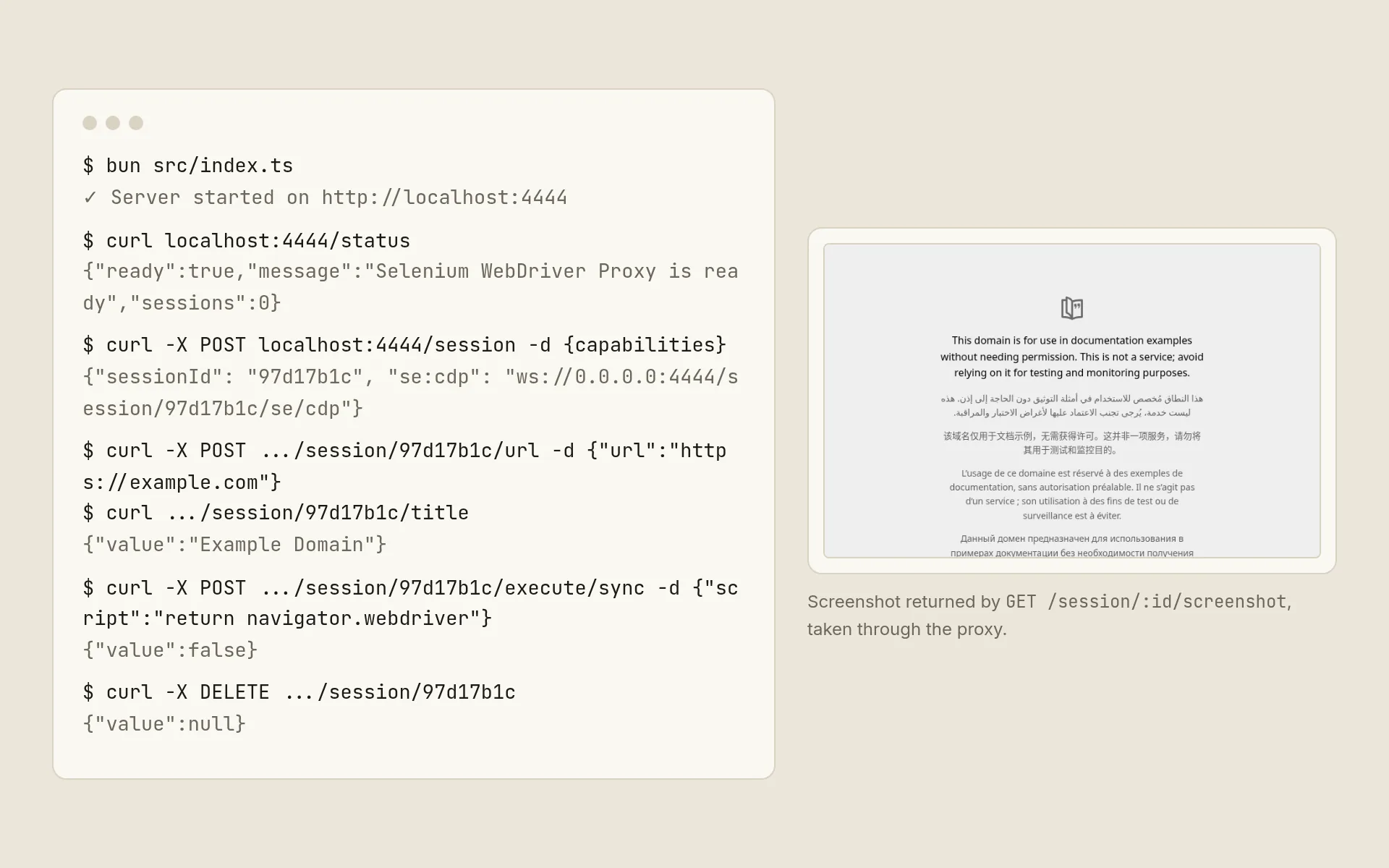
A W3C WebDriver server in TypeScript on Bun. Selenium clients talk to it as if it were ChromeDriver; underneath, it drives Chrome through Patchright.
How it works
- A small Express-style router on Bun’s native HTTP server, with routes like app.get and app.post.
- An abstract WebDriver class and a Patchright implementation (about 1,500 lines) that maps WebDriver commands onto Patchright calls.
- Each session gets a CDP WebSocket endpoint (se:cdp) for direct DevTools access, cleaned up when the session ends.
- Launches a persistent Chrome context and respects a user-data-dir passed in chromeOptions.
{
  "sessionId": "abc123",
  "capabilities": {
    "browserName": "chrome",
    "se:cdp": "ws://localhost:4444/session/abc123/se/cdp"
  }
}
Outcome
- In my local run, a session loaded example.com, returned its title and reported navigator.webdriver as false.